
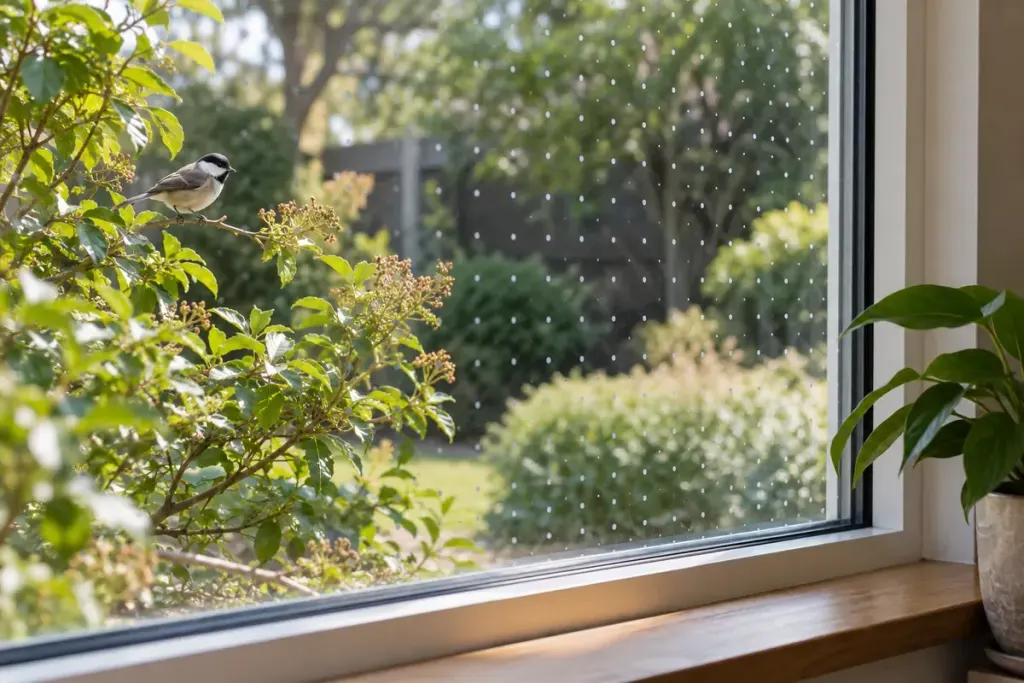
A window reflecting trees can look to a bird like a route into more trees. A dark bird-shaped sticker in one corner leaves most of that apparent route unchanged. Effective treatment needs to make the glass recognisable across the area a bird might try to fly through.
American Bird Conservancy’s guidance on birds and glass emphasises closely spaced, visible treatments. Exterior placement matters because it interrupts the reflection on the outside surface; an indoor decoration can be obscured by that reflection.
Inspect the window from the approach
Walk outside at different times of day and look at what the glass reflects. Note vegetation, open-looking passages and glass corners. Photograph the view for the building team, without assuming that a window with no recorded collision is necessarily safe.
Choose a tested treatment suitable for the surface and follow its spacing instructions. ABC commonly recommends a pattern with gaps no greater than about two inches, or five centimetres, in both directions. Product-specific requirements and installation details still matter.
For a community building, make one person responsible for checking the whole pane rather than approving a decorative sample. Patterns that are dense at eye level but sparse near the top leave untreated space. Transparent areas of doors and adjoining panels also deserve attention.
Before installation, confirm access, cleaning requirements, lease or building permissions and any glass warranty implications. Use qualified help for high windows; a wildlife project should not turn into unsafe ladder work.
Afterwards, keep a simple maintenance record. Note loose film, missing markers, cleaning changes and any observed strikes. A dated photograph taken from the same position makes it easier to see whether the treatment remains complete.
If a bird strikes the window, keep people and pets away and contact a local wildlife rehabilitator for guidance. Do not assume a bird is uninjured because it later moves or flies.
The design objective is visible coverage from the bird’s side of the glass. Once that is understood, the conversation moves from choosing a symbolic sticker to treating the actual surface that creates the problem.