
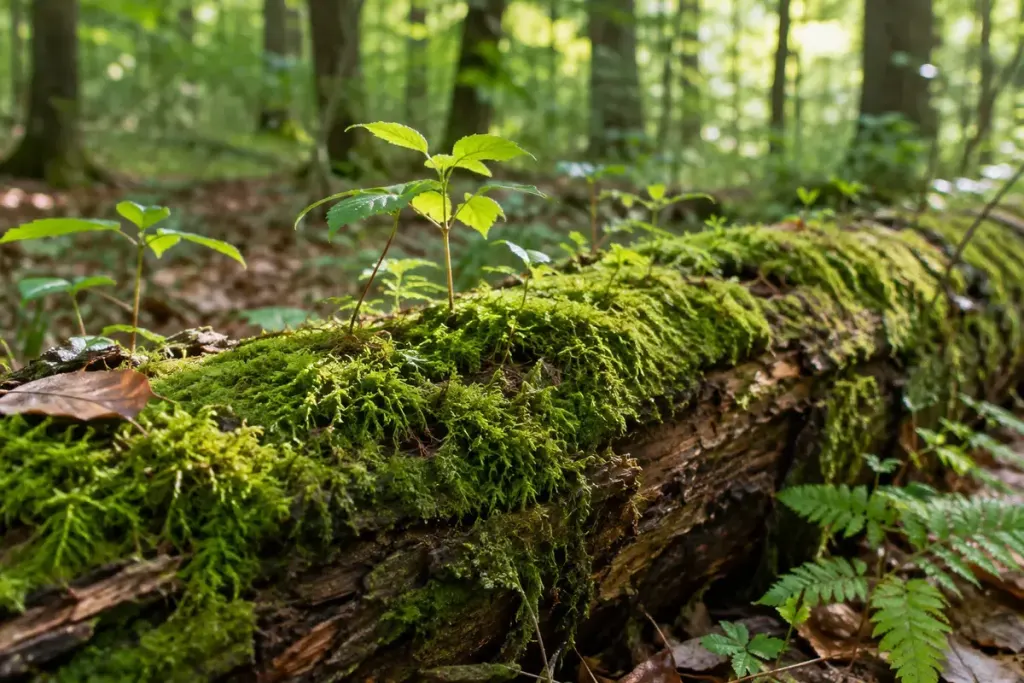
A fallen trunk can look like the end of a tree’s story. In a suitable woodland, its decaying surface may become a place where young plants begin. A nurse log supports new growth while the old wood gradually changes.
The National Park Service’s Muir Woods example describes a naturally fallen redwood providing nutrients and shelter to seedlings. It is a useful reminder that removing every fallen piece of wood can remove part of a living ecological process.
Look for a relationship, not just a green log
From a path or other permitted position, notice what is growing on the trunk. Are there mosses, small plants or tree seedlings? Can you see a difference between the surface of the log and the surrounding ground?
Do not pull a seedling to inspect its roots or strip bark for a better photograph. A simple observation can record the growth without damaging the place that supports it.
The National Park Service’s Spruce Nature Trail description also points to later stages: rows of trees can remain after the supporting log has decayed away. That documented example gives a visitor something to look for, but a straight row elsewhere is not, by itself, proof of the same history.
Turn a walk into a modest recording project
A community group could choose one safely accessible fallen trunk, with the land manager’s agreement, and photograph it from the same position at intervals. Record the date, broad conditions and visible changes. Use a fixed landmark in the view rather than attaching a marker to living growth.
Keep descriptions proportionate to the evidence. “Three small seedlings visible on the upper surface” is useful even if the species is not yet known. Add an identification later if someone qualified can confirm it.
Leaving wood requires a place-specific decision
The ecological value of dead wood does not mean every fallen tree should remain exactly where it lands. Paths, unstable trees, fire management and other site responsibilities require assessment by the land manager. Volunteers should not move or cut large timber to create a display.
The constructive question is where wood can safely remain and what can be learned from it. A nurse log offers a small, visible example of renewal that does not begin with clearing everything away.