
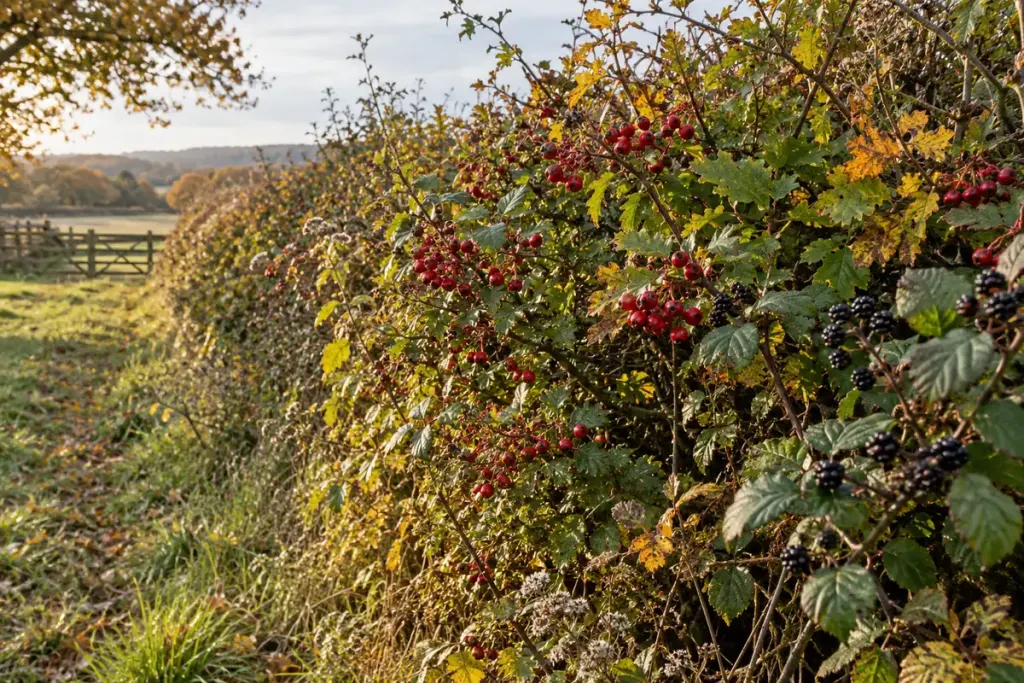
A hedge does more than mark the edge of a garden. Its flowers, leaves, fruit and branching structure can provide different resources through the year. Choosing several suitable native shrubs can create a more varied habitat than selecting every plant solely for an identical appearance.
The Royal Horticultural Society’s mixed-wildlife-hedge guidance explains the value of food, shelter and nesting opportunities. Its species suggestions are rooted in a British gardening context. “Native” is location-specific, so a reader elsewhere should use local ecological and horticultural advice rather than transplant the list unchanged.
Choose for the site the hedge will actually occupy
Record the available width, light, soil conditions and exposure. Think about the mature hedge, not only the small bare-root plants. A narrow path, neighbouring windows or underground services can make a large, vigorous species unsuitable even when it is valuable for wildlife in another setting.
Ask a knowledgeable local nursery or habitat adviser which mixture suits those conditions. Consider flowering and fruiting periods, growth rates and maintenance needs. Diversity should be a planned combination, not an arbitrary collection of everything labelled wildlife-friendly.
Give establishment its own budget of time. Young plants need appropriate watering, competition control and protection while their roots develop. Agree who will inspect the hedge during dry spells if it belongs to a shared space; a planting day is not the end of the project.
Plan care around the habitat you are creating
Before cutting, check for active nests and follow local wildlife protections. Review whether the chosen trimming routine allows the species to flower or fruit. An extremely frequent cut may prevent some of the seasonal resources that motivated the planting.
Keep a simple record of which species were planted where and note failures without assuming the whole mixture is unsuitable. A wet corner and an exposed edge may need different responses.
Over time, judge the hedge by how it grows and is used, not by whether every shrub looks the same. A varied boundary can still be carefully designed; its coherence comes from suitability and care rather than uniform colour.