
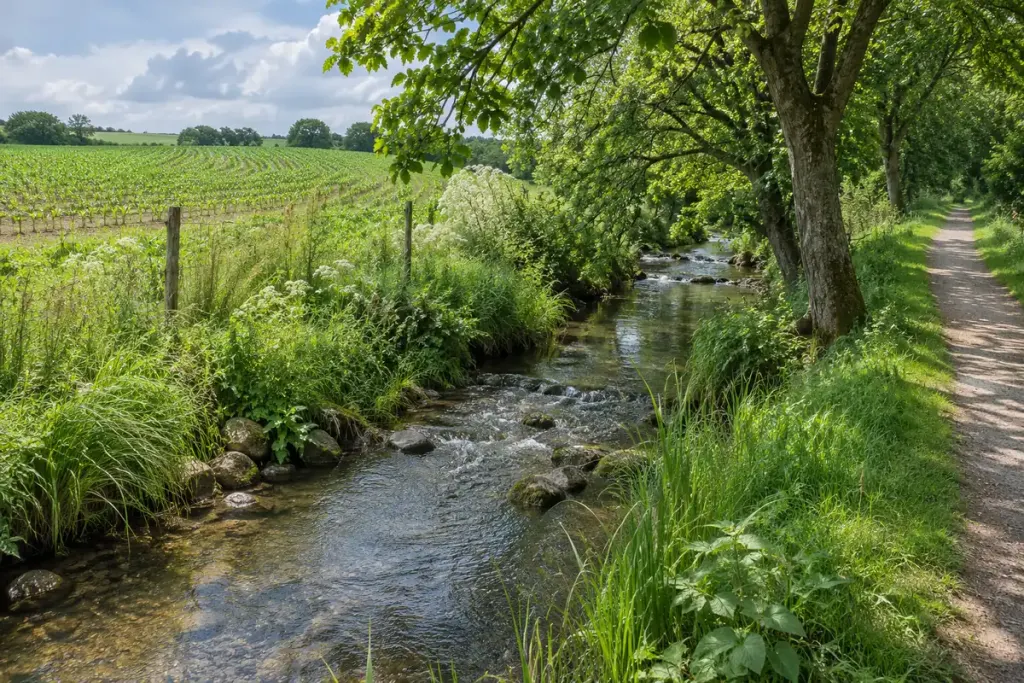
A narrow strip beside a stream may look like unused ground. In a conservation project, it can be the connection between what happens on the surrounding land and what reaches the water. A riparian buffer is managed with that relationship in mind.
The US Forest Service’s riparian-buffer guidance describes areas of trees, shrubs and other perennial plants beside water. Depending on the site and design, they can help filter runoff, stabilise banks, provide shade and support habitat. They do not make every pollution source harmless or remove the need to manage activities upstream.
Choose the problem before the plants
Is the project concerned with exposed soil, a lack of shade, habitat connections or runoff from adjacent land? Record the purpose and ask a local conservation specialist which design fits the stream, soils and land use. There is no single width or species list that suits every place.
Check ownership, access rights and any permissions affecting work near water. A community planting day should follow that preparation, not be the moment someone discovers the group cannot alter the bank.
Plan the years after planting
Assign responsibility for establishment care, invasive plants, damage checks and replacement of failed planting. Protecting a young area from accidental mowing can be as important as the launch event. Make the maintenance instructions understandable to whoever manages the surrounding land.
For a volunteer record, photograph the same viewpoints over time and note what was planted, when and by whom. Record observations separately from conclusions. Clearer-looking water after planting does not by itself prove the buffer caused the change.
Ask the technical adviser what monitoring would demonstrate progress toward the project’s actual objective. Survival of planting, bank condition and habitat observations answer different questions. A modest, maintained buffer with a clear purpose is a stronger project than an impressive planting total that nobody revisits.