
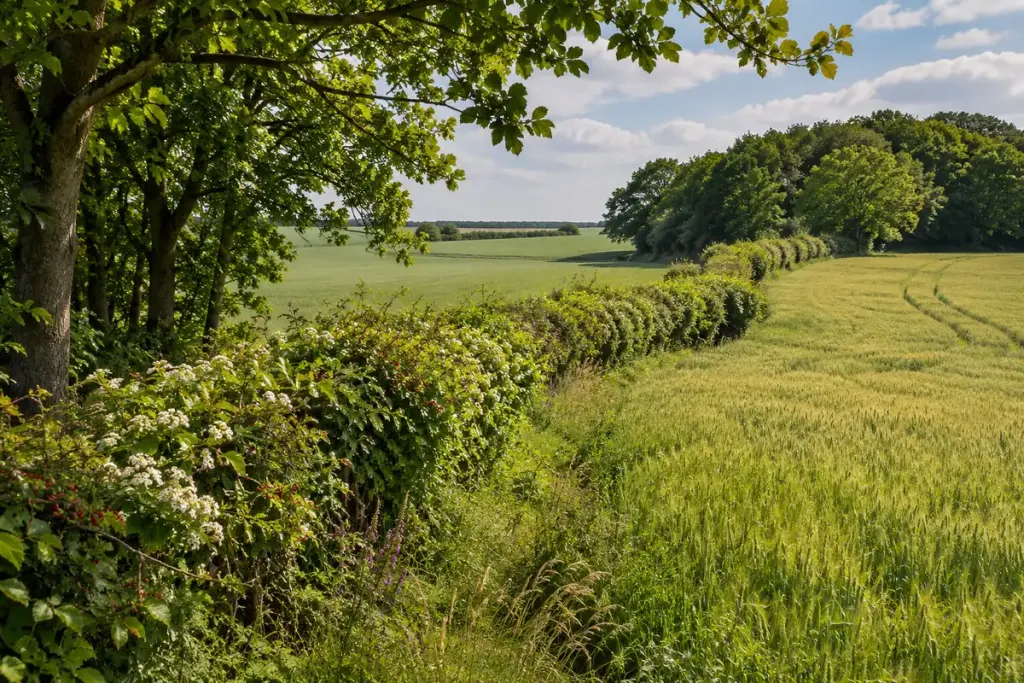
On a planting plan, a hedge may appear as a neat line around a site. For wildlife, its relationship with the surrounding landscape can matter as much as the length of that line.
A hedge can provide habitat in its own right and help connect other habitat patches. Those functions make it worth looking beyond the boundary of a single garden or community plot.
Ask what the line connects
The Woodland Trust’s guide to hedgerows describes food, shelter, and movement routes for wildlife in the UK. It notes that some species, such as hazel dormice, struggle to cross large open areas. The ecological value of a connection depends on the species and landscape concerned.
Before proposing a new hedge, sketch existing trees, scrub, hedges, roads, paths, and open areas. Mark the features that are already valuable. A blank-looking area on a simple plan may be another habitat that should not be planted over.
Seek local ecological advice on suitable species and placement. A list of plants useful in one country is not automatically suitable elsewhere, and a corridor for one species may not serve another in the same way.
Design the care as well as the planting
For a community project, discuss ownership, access, watering during establishment, replacement of failed plants, and future management. Agree who will make decisions about cutting and check wildlife protections before scheduling work.
Imagine two proposed routes of equal length. One links an existing hedge to woodland; the other ends at a busy paved area. That drawing does not establish which is ecologically best, but it shows why metres planted alone are an incomplete success measure. An informed site assessment can investigate what each route would actually provide.
Keep dated photographs from agreed viewpoints and record maintenance actions. Avoid claiming that wildlife movement has improved simply because the hedge has grown. Observations need an appropriate method and period of study. A good project can report the work it has completed honestly while continuing to learn whether the intended habitat connection is developing.