
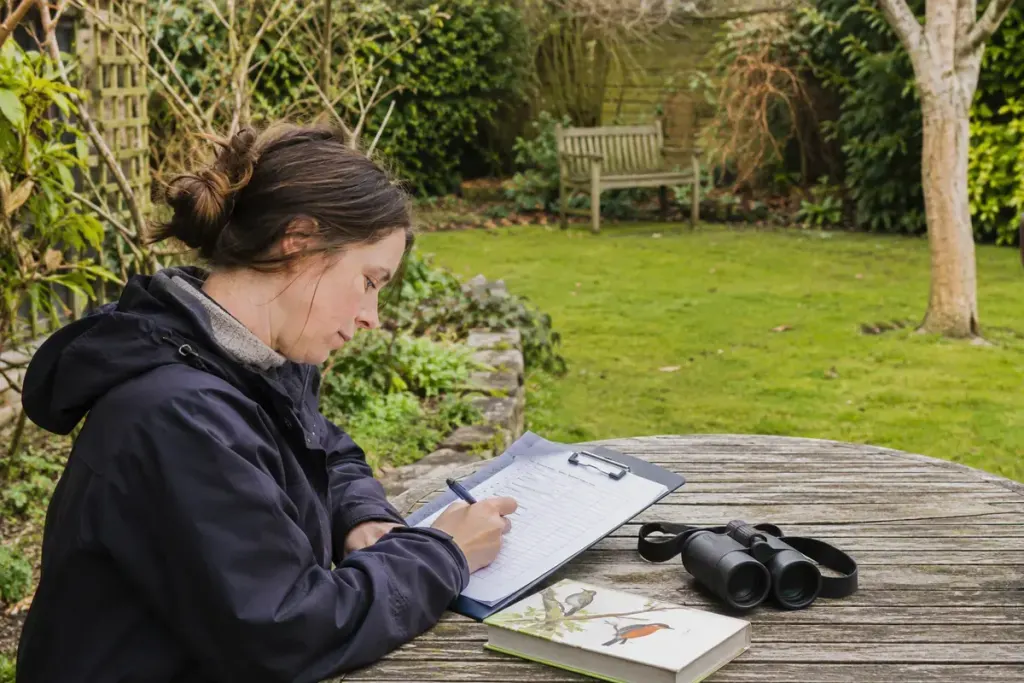
A volunteer returns from a bird survey and says, “I saw none.” That sentence could describe careful observation for half an hour, a brief glance from a doorway or a visit abandoned before it began. The same apparent zero can hide very different evidence.
Citizen-science projects need the observation method as well as the sightings. In eBird’s guidance on complete checklists, completeness means reporting all the birds the observer identified by sight or sound during the observation period. It does not mean that every bird present was detected.
No detection is different from no survey
For a community project, record whether the planned survey actually took place, where it occurred and what effort was made. Follow the project’s own protocol for duration, route and conditions. A missed visit should not be quietly entered as a completed survey with no wildlife.
Consider two fictional records. One says “No target species detected during the agreed 20-minute watch.” The other says “Visit cancelled because access was closed.” Combining them as two zeros would erase an important difference.
The recording system may also have a specific way to represent non-detection. Do not invent zero-count species entries in eBird; a complete checklist provides information through the species reported and the observation context. Other schemes may explicitly request a target-species zero. Follow the scheme rather than transferring a rule from a different project.
Keep the conclusion proportionate
A non-detection does not prove absence. The organism may have been present but unseen, silent, hidden or outside the observer’s effective view. Repeated, consistent observations can be more informative than one unusually busy or quiet visit.
When sharing results publicly, describe the evidence: “not detected during these surveys” is more precise than “does not occur here.” Keep raw records, including effort and missed visits, so the project can distinguish ecological changes from changes in observation.
The quiet survey can be valuable. Its value comes from knowing what was actually done, not from treating an empty species list as self-explanatory.