
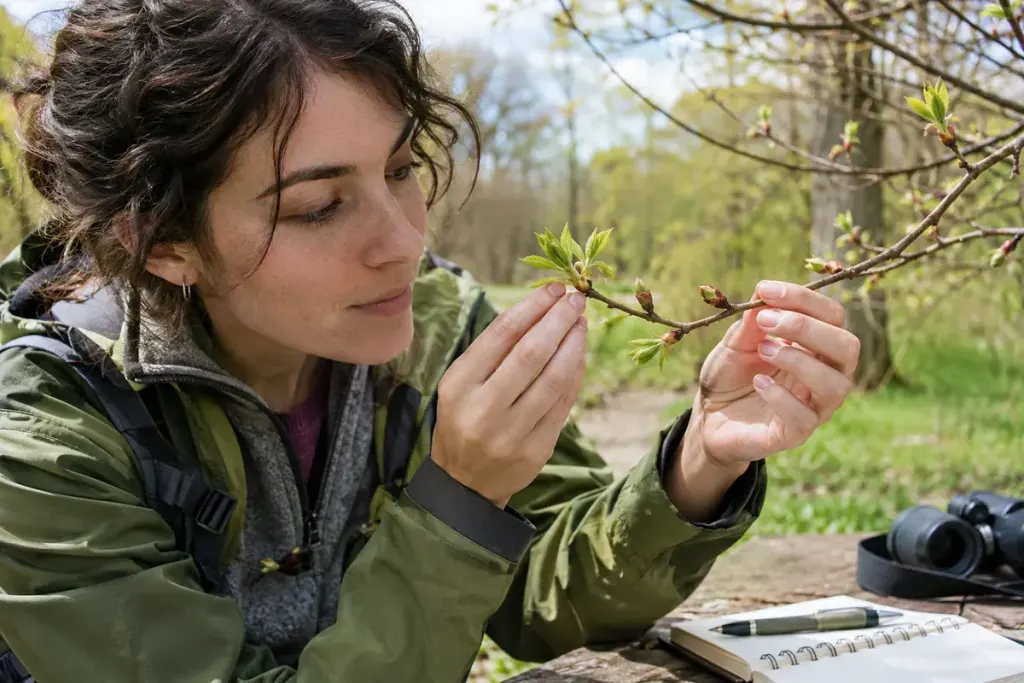
One volunteer records “leaves appeared” on Monday. Another visits the same tree and records the same event on Thursday. They may have observed different stages rather than disagreed about the date.
Phenology tracks recurring biological events and their timing. A useful record needs an operational definition of the stage being observed. The USA National Phenology Network’s observation guidance distinguishes stages such as breaking leaf buds and visible unfolded leaves, with definitions for the relevant plant.
Choose the definition before the first visit
Identify the species and the individual plant, then read the project’s instructions. A bud beginning to open is not automatically an unfolded leaf, and one open flower is not necessarily the same measure as peak flowering.
For a community observation project, take the protocol to the plant and discuss an example together. Record uncertainty honestly using the method the project provides. A confident guess can be less useful than a clearly marked uncertain observation.
Imagine visits on Monday and Thursday. If the stage was absent on Monday and present on Thursday, the first observed presence is Thursday. The event may have begun between visits. Keep that interval visible rather than claiming an exact biological start time that nobody witnessed.
Repeat the observation, not the assumption
Use the same plant and viewing area where the protocol calls for it, and record the visit date even when the answer is “not yet”. Absence observations help establish the interval in which a change occurred.
A photograph can support the record, but it does not replace species-specific definitions or a consistent method. Note relevant problems such as pruning, damage or loss of access.
Over time, carefully defined observations can support comparisons across seasons and sites. The strongest contribution is not the earliest exciting date; it is a traceable record showing what was checked, what was seen and where uncertainty remains.