
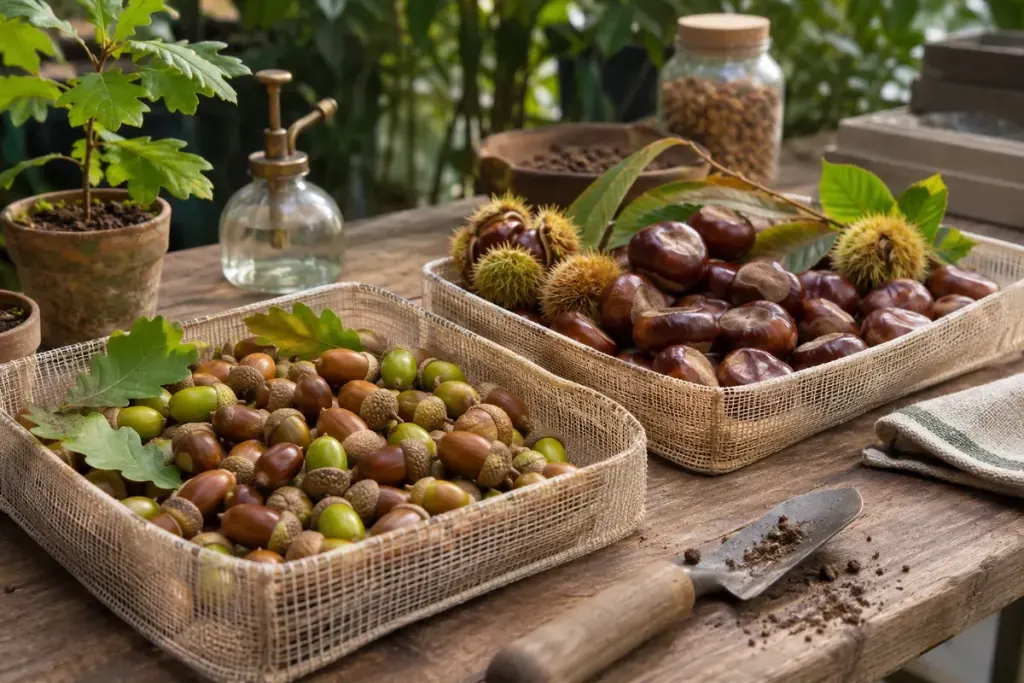
A dry packet in a freezer is a powerful conservation tool for many seeds, but it is not a universal solution. Some species produce seeds that lose viability when dried. Putting them through an ordinary seed-banking process can destroy the very material intended for preservation.
Kew’s seed-collection overview identifies these drying-sensitive seeds as recalcitrant. It also explains that other exceptional species may resist conventional storage for different reasons, so the problem is broader than a simple divide between “easy” and “difficult” seeds.
Storage behaviour belongs to the species
Kew gives oaks, chestnuts and horse chestnuts as examples of trees with recalcitrant seeds. That helps explain why familiar large seeds cannot automatically be handled like a packet of dry garden seed.
For a community tree project, identify the species before planning collection and storage. Ask a competent nursery or conservation organisation for a suitable, species-specific method. A general instruction to “dry everything thoroughly” is not enough.
Plan the destination before collecting
Establish who will receive the material, when it will be used and what permissions apply to collection. Keep the identity and collection location attached to each batch. Avoid mixing uncertain material into a clearly identified collection.
If the project cannot provide appropriate handling or an agreed destination, collecting a larger quantity does not necessarily improve the conservation outcome. It may simply create more material that cannot be maintained.
Specialist preservation is active research
Kew’s cryopreservation research investigates approaches for tree species that conventional seed banking cannot preserve. This is specialised work involving the biology of the material and carefully developed procedures, not a recommendation to place fresh seeds in a household freezer.
A useful project record separates three questions: what species is this, what storage behaviour is known, and which method has been agreed? Leave uncertainty visible and seek advice where identification or handling is unclear.
The lesson is encouraging rather than discouraging: conservation methods can be adapted, but only when the living material’s requirements are understood. A seed bank succeeds through appropriate care, not through applying one storage recipe to everything.