
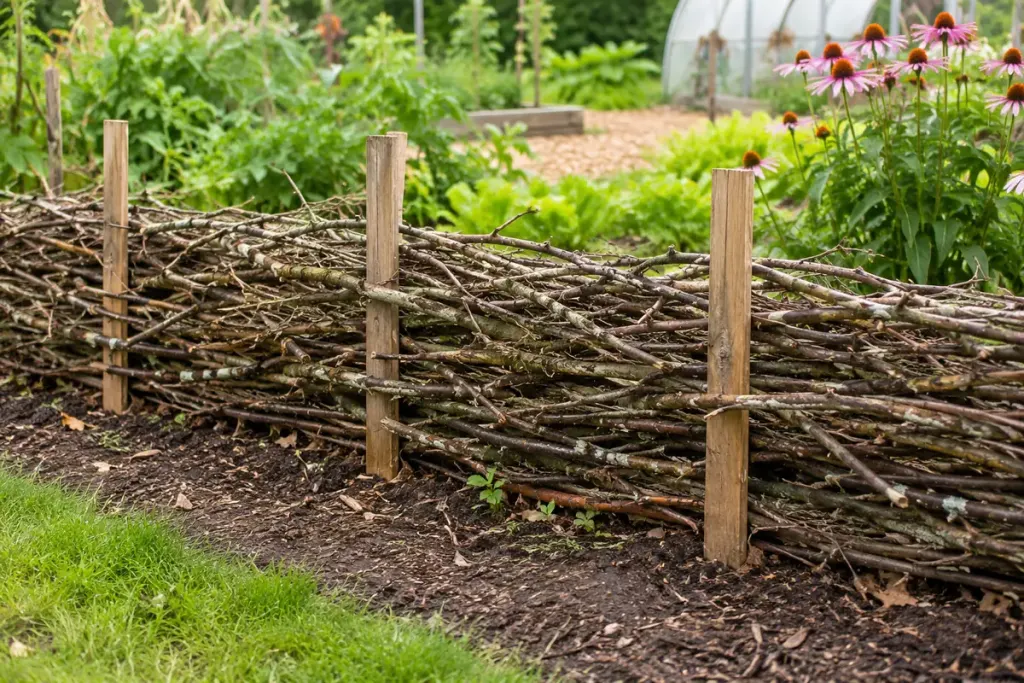
A line of woven or stacked branches can look like the beginning of a planted hedge. A dead hedge is different: its structure comes from retained woody material, often held between supports, rather than a row of shrubs growing into a barrier.
The Royal Horticultural Society’s dead-wood habitat guidance describes dead hedges as a use for woody prunings that can provide immediate cover. The name identifies the material; it does not mean the feature is devoid of life.
Draw the future as well as the first-day shape
A planted hedge may increase in height and density as its shrubs establish. A dead hedge’s branches instead settle and break down. Its outline can therefore become lower or more open unless the feature is managed and, where appropriate, replenished.
Imagine a community plot needing a low visual division between two working areas. The group already has suitable prunings, but volunteers expect a permanent, solid screen. A sketch showing the initial shape and a later, settled shape would expose that mismatch before work begins.
The decision is partly about purpose. A modest habitat boundary and a required security fence are not the same specification. Nor should a branch structure be assumed to provide an approved safety barrier simply because it looks substantial.
Describe the material in the handover
Instead of recording “hedge maintenance,” identify what actually needs checking: supports, protruding ends, gaps and the changing branch layer. Living plants that later establish nearby are a separate part of the feature. Do not assume every cut branch is intended to root or that a dead hedge should be pruned like a row of growing shrubs.
Any construction needs to suit the site, access requirements and the people responsible for it. Appropriate plant-health and wildlife advice should guide material selection and later work.
Use change as information
Photograph the same short section from an agreed viewpoint over time. Note settling and maintenance separately from wildlife observations. That record can show how the structure behaves without dismantling it to look for occupants.
The useful expectation is a managed feature made from material that changes. Understanding that difference at the outset helps volunteers choose a boundary they can care for, rather than waiting for cut branches to behave like a newly planted hedge.