
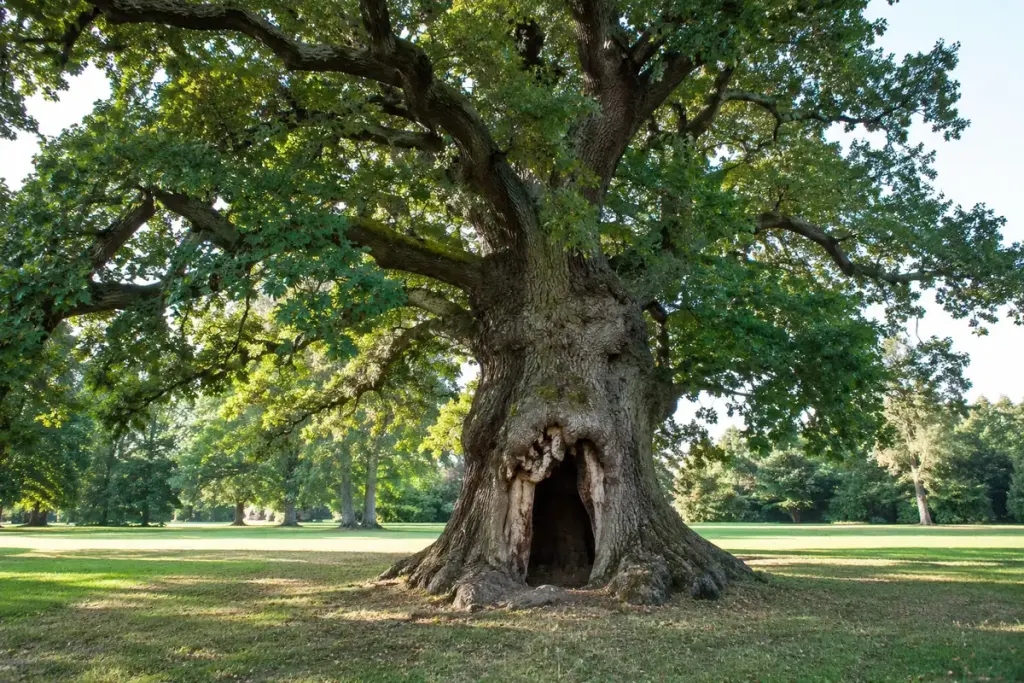
A tree with a hollow trunk and weathered branches can be valuable long before anyone agrees on its exact birthday. When community groups record special trees, the words ancient and veteran help describe different aspects of their history and habitat features.
The Woodland Trust’s assessment guide distinguishes great age relative to the species from veteran features such as significant decaying wood and hollowing. Its newer guidance on recognising and categorising these trees develops the life-stage approach. Size alone is not a reliable age certificate.
Observe features before assigning a label
From a safe, permitted position, note the species if you can identify it, the overall form, visible cavities, deadwood and the setting. Record uncertainty honestly. “Species not confirmed” is more useful than a confident but unsupported identification.
A small tree on an exposed site may have a long history, while a large tree elsewhere may be younger than its appearance suggests. Avoid turning trunk girth into an exact age without appropriate species and growth-context knowledge.
Make the record useful to someone else
For a community walk, prepare a simple sheet with date, location, photographs and observed features. Use a consistent photographic viewpoint where practical, without climbing or disturbing cavities. Keep the location precise enough for an authorised recorder to find the tree again.
Separate ecological observations from a safety assessment. A cavity or fungus is not, by itself, a conclusion that a tree must be removed or is safe to stand beneath. Management decisions near paths and buildings require competent assessment.
Do not tidy away attached or fallen deadwood simply to improve the photograph. Discuss care with the landowner and relevant specialists, particularly where protected habitats or species may be involved.
The purpose of the record is to make an overlooked living feature visible in the community’s knowledge. A careful description can support later identification and conservation even when the first visit ends with a question mark beside the classification.