
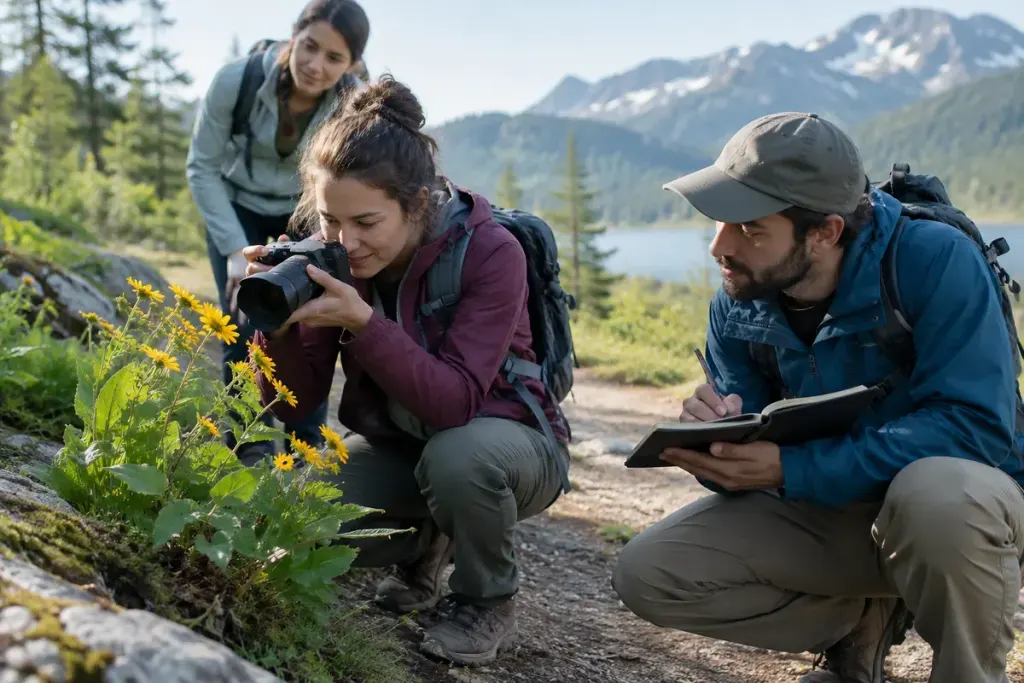
A community nature day can produce hundreds of photographs and an enthusiastic list of species. Turning that enthusiasm into useful records takes a little planning before people spread out across the site.
The Natural History Museum describes a BioBlitz as a time-limited effort to find and identify wildlife in a defined area, bringing specialists and the public together. Its value includes learning and a snapshot of what was observed, rather than a complete inventory of everything that lives there.
Agree how an observation becomes a record
Choose the receiving recording scheme or platform with the organisers. Establish the fields it needs, such as date, location, observer and identification. Decide who reviews uncertain records and how photographs will be associated with them.
Do not force a precise species name when the evidence only supports a broader identification. A clear photograph labelled as uncertain can be more useful than a confident guess. Record what was observed without disturbing wildlife to obtain a better image.
Explain the site’s boundaries and permissions. Participants should not enter private land, handle protected species or move animals for the sake of increasing the count. Local experts can advise on sensitive habitats and appropriate observation methods.
Keep the public summary honest
A report might say that participants recorded a certain number of verified species during the event’s hours. It should not claim that unrecorded species are absent. Weather, season, observer experience and the time spent in each area all influence what is found.
Check how location data will be shared, particularly for sensitive species. Obtain appropriate consent before publishing identifiable photographs of participants, and follow the chosen recording scheme’s data rules.
For the organising team, a short debrief can ask which records were easy to verify and which lacked useful detail. Improve the recording instructions for the next event rather than treating the largest possible total as the only measure of success. A smaller set of traceable observations can contribute more than a long list nobody can check.