
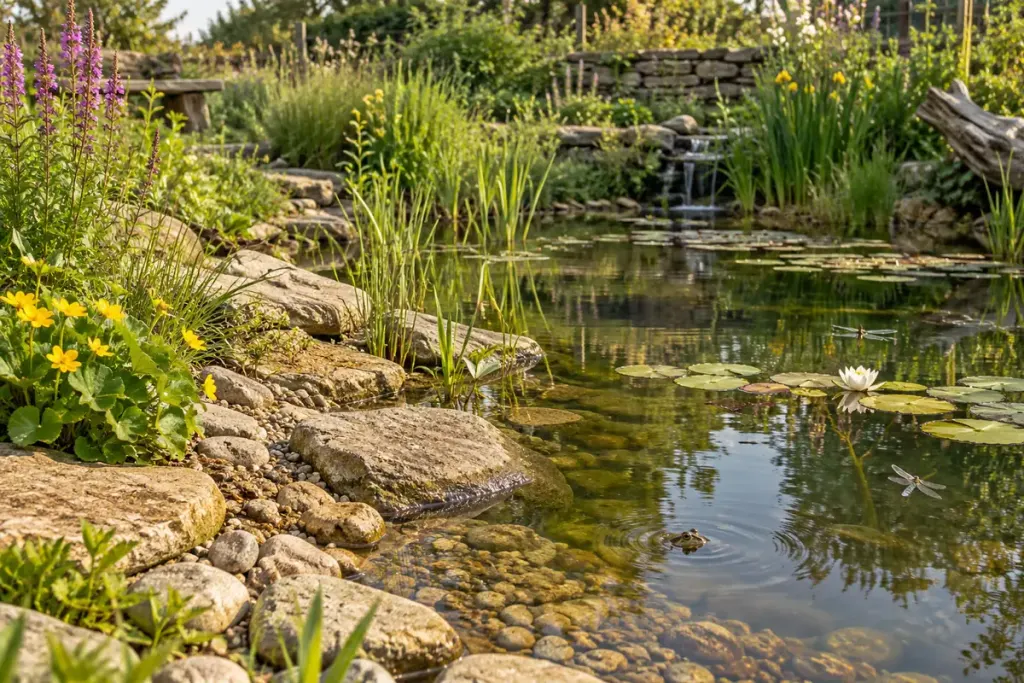
A wildlife pond is often imagined from above: a patch of water, a few plants and reflections of the sky. For animals approaching from the ground, the edge is one of its most important features.
The Royal Horticultural Society’s wildlife-pond guidance recommends a long, shallow slope on at least one side. This provides a gradual transition rather than a steep drop. Its advice is written for UK gardens; plant choices and seasonal conditions should be adapted to your location.
Sketch the pond from the side
A side-view drawing makes shallow margins easier to plan. Show the expected waterline and consider what happens if it falls. An exit that works only when the pond is completely full may become inaccessible during a dry period.
Choose stable materials that do not create a loose, slippery pile. Avoid sharp edges and check that any proposed liner or container is suitable for the intended use. Plan where people will stand for maintenance without trampling the shallow margin.
Wildlife access and human safety are separate requirements. A shallow slope does not make a pond safe for unsupervised children. Consider barriers, supervision and site-specific advice before installing any water feature where children or vulnerable people may encounter it.
- Check the location for buried services before digging.
- Plan overflow so it does not create a nuisance or damage.
- Use locally appropriate plants from responsible sources.
- Avoid moving wild animals into the pond to speed up colonisation.
After filling, observe how the edges behave through rain and dry weather. Look for exposed liner, unstable stones or a route that has become too steep. Make adjustments carefully, taking account of any wildlife already present.
If a pond is unsuitable for the household or site, a different water feature may still be useful. The most successful habitat project is one that fits the place and can be maintained responsibly.